A Hybrid Quantum–Classical Perspective on AI Innovation in Life Sciences Commercialization.
Start with the business problem, not the quantum processor
AI solutions take many forms, but their business applications often share recognizable patterns. These patterns provide a useful starting point for a more focused question: where might quantum computing complement an AI solution—and what would it need to prove?
For life sciences commercial organizations, the opportunity is not to replace established AI and data platforms. It is to identify specific computational challenges within those platforms that could be candidates for quantum-assisted approaches. A hybrid architecture provides a practical framework for exploring that possibility.
Seven patterns of AI
1. Recognition systems. Interpret and classify unstructured inputs such as images, audio, video, and text. Examples include facial recognition, medical image analysis, and extracting information from invoices.
2. Conversational and human interaction. Enable people to interact with machines through natural language. Examples include virtual assistants, customer support chatbots, and interactive tutoring tools.
3. Pattern and anomaly detection. Identify recurring structures, unusual behavior, or outliers in data. Examples include fraud detection, cybersecurity monitoring, and identifying early signs of equipment failure.
4. Predictive analytics and decision support. Estimate future outcomes or probabilities to inform human judgment. Examples include demand forecasting, patient readmission risk assessment, and financial forecasting.
5. Goal-driven systems. Evaluate actions and strategies against a defined objective. Examples include route planning, scheduling, and game-playing agents; reinforcement learning is one approach within this pattern.
6. Hyperpersonalization. Use individual preferences, behaviors, and contextual information to tailor recommendations or interactions. Examples include content recommendations and personalized engagement.
7. Autonomous systems. Combine perception, decision-making, and action to operate with limited human intervention. Examples include self-driving vehicles and autonomous drones.
These patterns are not mutually exclusive. A customer service assistant, for example, may combine conversational AI to engage a user, recognition to interpret an uploaded product image, and predictive analytics to anticipate the next support need.
Where quantum computing enters the picture
The connection to quantum computing lies beneath these application patterns, in the computational tasks they require. A forecasting solution, for example, may also include a constrained allocation problem. An engagement platform may need to select among many possible combinations of actions, channels, and timing.
These are candidates for investigation—not evidence of quantum advantage. A large dataset or a complex decision does not, by itself, make a problem suitable for a quantum computer. The relevant questions are whether the task can be formulated for a quantum algorithm and whether the resulting approach can outperform a strong classical baseline on a meaningful measure.
Superposition and entanglement are resources for quantum computation, but they should not be interpreted as a mechanism for evaluating and reading out every possible answer at once. Any practical benefit depends on the algorithm, data representation, hardware, and measurement process.
A hybrid architecture: classical orchestration, quantum experimentation
A hybrid approach combines classical computing resources, such as CPUs and GPUs, with a quantum processing unit (QPU). The classical system retains responsibility for data preparation, workflow orchestration, and evaluation. A selected computational component is assigned to the quantum processor.
For the noisy intermediate-scale quantum (NISQ) devices described in this approach, hardware noise and limited circuit depth constrain what can be executed reliably. Hybrid workflows offer a way to explore selected quantum computations without attempting to move an entire enterprise application onto quantum hardware.
How a variational hybrid loop works
One important hybrid design uses an iterative feedback loop between a classical optimizer and a parameterized quantum circuit:
1. Formulate the problem. The classical system prepares the inputs, defines the objective and constraints, and initializes the circuit parameters.
2. Run the quantum circuit. The QPU prepares and transforms a quantum state using those parameters. Repeated measurements produce estimates needed to evaluate the objective.
3. Update the parameters. The classical optimizer evaluates the results, adjusts the parameters, and submits the next circuit execution.
4. Evaluate and stop. The loop continues until a stopping criterion is met, such as an iteration limit, a resource budget, or sufficiently small improvement. The result is then checked against business constraints and classical alternatives.
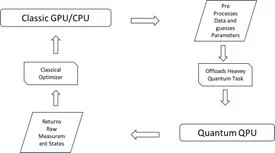
An Iterative feedback loop
This process seeks a useful solution; it may not guarantee the best possible answer. The Variational Quantum Eigensolver (VQE) and the Quantum Approximate Optimization Algorithm (QAOA), referenced in this discussion, illustrate the variational hybrid approach. Not every hybrid quantum workflow follows this exact loop.
What this means for life sciences commercialization
Commercial organizations work with interconnected information, including claims, electronic health records, physician networks, and formulary structures. The most useful starting point is not to move all of that data onto a QPU, but to isolate a well-defined decision problem within the broader workflow.
Potential areas for exploration include:
· Constrained allocation: Evaluate how limited resources might be distributed across competing priorities under explicit business constraints.
· Engagement planning: Explore combinations of channels, timing, and actions within a goal-driven or personalized engagement workflow.
· Pattern detection and prediction: Investigate whether a quantum machine learning component improves a narrowly defined task relative to established classical methods.
These examples are research directions, not claims of established commercial benefit. Any pilot should define success before implementation: solution quality, execution time, total cost, robustness, and compliance with applicable data and business requirements.
Why the hybrid model matters—and where it falls short
The value of a hybrid architecture is selective integration. It allows teams to test a quantum component while retaining the classical infrastructure needed to manage data and operate the business workflow.
It does not eliminate hardware noise or establish computational advantage. Shorter circuits may reduce exposure to some errors, but short circuits are not, by themselves, an error-mitigation method. Repeated measurements, data encoding, classical optimization, and communication between systems also contribute to the overall workload and must be included in performance comparisons.
The leadership takeaway
The seven AI patterns help describe what an intelligent application does. A hybrid quantum-classical architecture addresses a different question: how might a specific part of that application be computed?
For life sciences leaders, the next step is disciplined experimentation: select a consequential problem, establish a credible classical benchmark, and test whether a quantum component adds measurable value. The goal is not to attach a quantum label to AI. It is to determine where quantum computing can earn a role in the solution.